
ENCOD BULLETIN ON DRUG POLICIES IN EUROPE
NOVEMBER 2011
TIME TO ACT
What do pleasure and pain have in common? Current policy towards drugs. Prohibition has brought millions of people to their knees and whole societies are suffering. It is time to replace punitive approaches with new forms of drug treatment and drug policy.
Towards the end of 2011, it seems as if the values that we have known for many years have started to change completely. The financial crisis is an opportunity to come to terms with many inefficiencies in the political system, among others drug policy. It is now absolutely clear that this policy is not based on scientific and technical evidence, but on the desire to maintain and carry out punitive control of certain pleasure. Yes, pleasures! In the flood of discourse on drug policy we have completely ignored this fundamental truth. It seems that some people do not want to allow others to enjoy pleasure, even if this causes suffering and war.
It is now time to act. Globally it has become clear that current drug policies need to be redefined. Until recently it was mostly former politicians who were calling for a change in legislation. In the past weeks the current president of Colombia has started to do so. But these calls are facing difficulties. Long lasting prejudices towards drug users in general that are kept alive by public actors and even NGO’s that are working on so called “holistic” approaches, strengthen the perception that prohibition is the only answer.

During the 6th session of the EU Civil Society Forum on Drug Policy that was held in Brussels between the 10th. and 12th. of October, no consensus was possible among the participants, exactly because of this fundamental “gap” between approaches towards drug policies that are based on totally different concepts. The main cause of misunderstanding is that prohibitionist NGOs just can not comprehend that some people deliberately choose to use drugs and do this in a responsible way.
For these NGO’s, drug use is an illness or condition that must be prevented. They simply refuse to listen to people who explain to them that their main reason for taking drugs is to make life more enjoy- and, for some, more bearable. They close their eyes and ears when evidence is presented that cannabis and other drugs are extremely useful to treat and prevent diseases.
Prohibitionist NGO’s represent a tiny minority of people who are concerned by the drug issue. They are selected deliberately by the European Commission to participate in the Civil Society Forum, in order to prevent the CSF from reaching any consensus. Thus the Commission can continue to divide and rule, sending out messages like the Communication ‘Towards a Stronger Response to Drugs‘. In this preview of the announced EU Drug Strategy 2013-2020 the Commission promises to strengthen the policies which they know are not working, since this was proved by the research report that was published by the European Commission in 2010 . On the other hand, studies show that the total amount of income that could be generated by a combination of decriminalization of drugs (leading to a significant reduction in law enforcement) and legal regulation of the cannabis market in the EU is estimated between 35 and 60 billion euro (that is between 70 and 120 euro per capita per year). The Brussels bureaucrats don’t even care. Their sole purpose is to ensure the wasteful and damaging status quo.

The current global crisis is most of all a crisis of values. If we want to put the world back in order we must change our approaches to general issues. It is time to start a local call for amending drug laws. Policy and legislation concerning drugs should be changed in order to truly serve people. In particular, new legislation should be based on facts, not on the desire to repress.
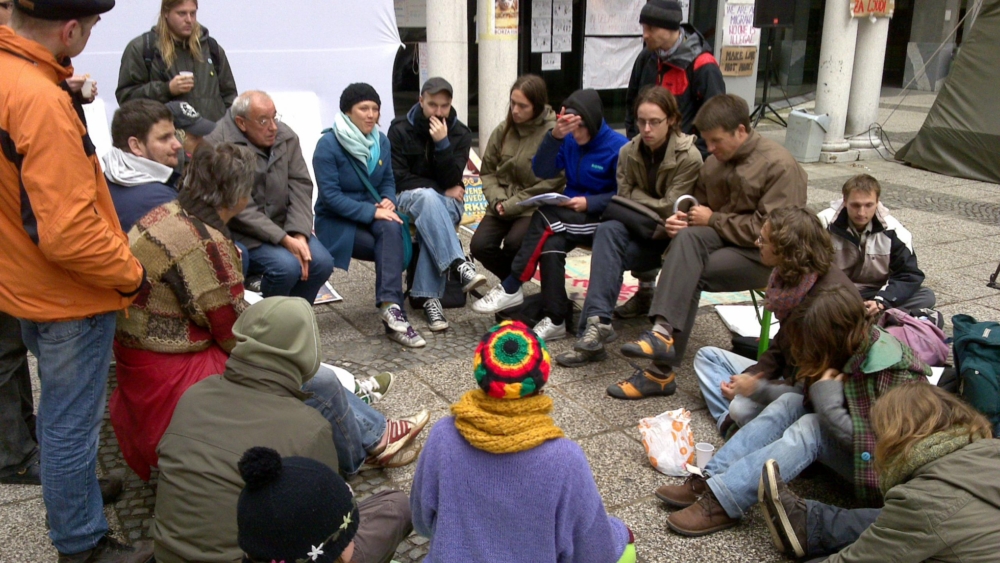
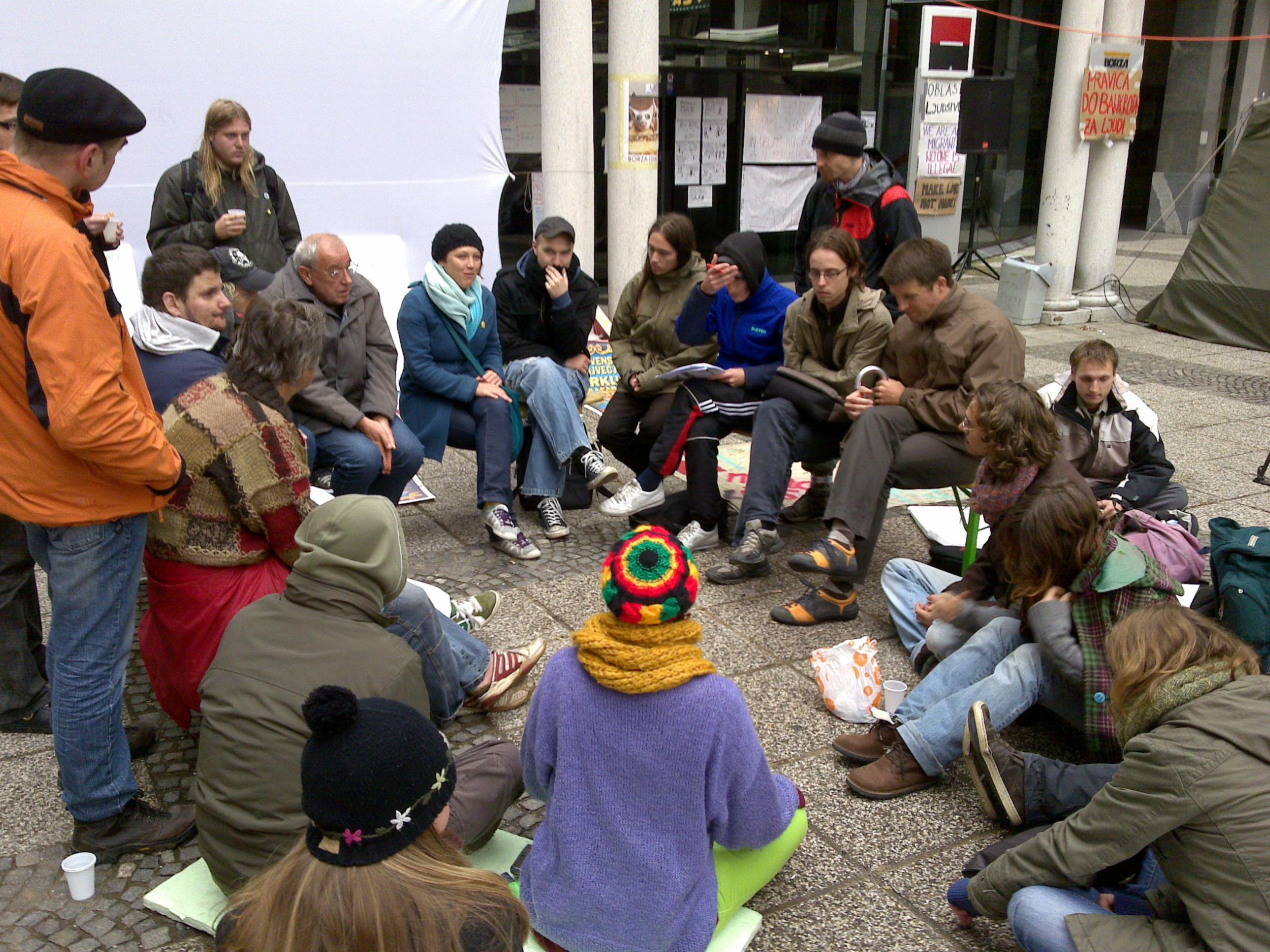
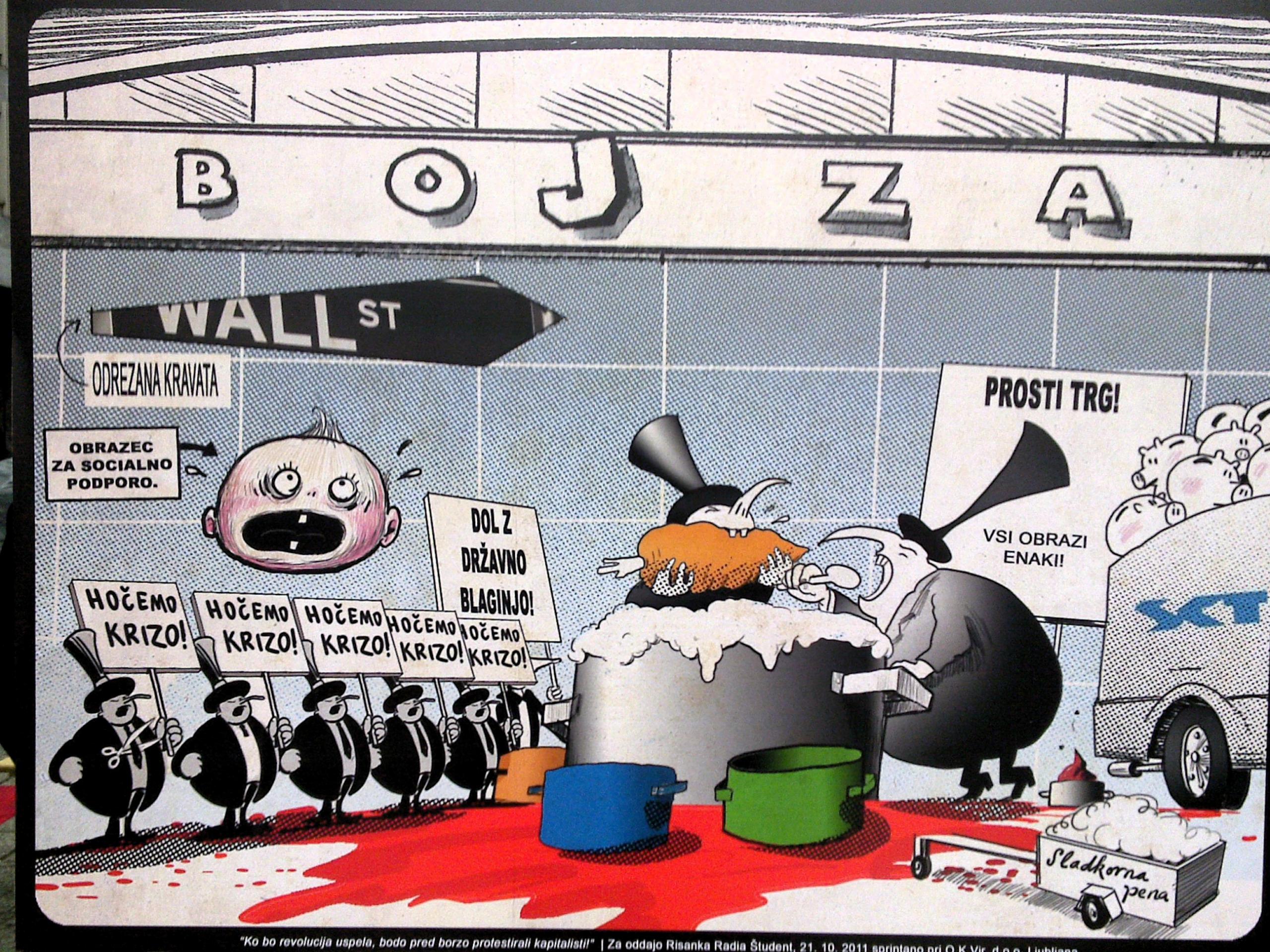
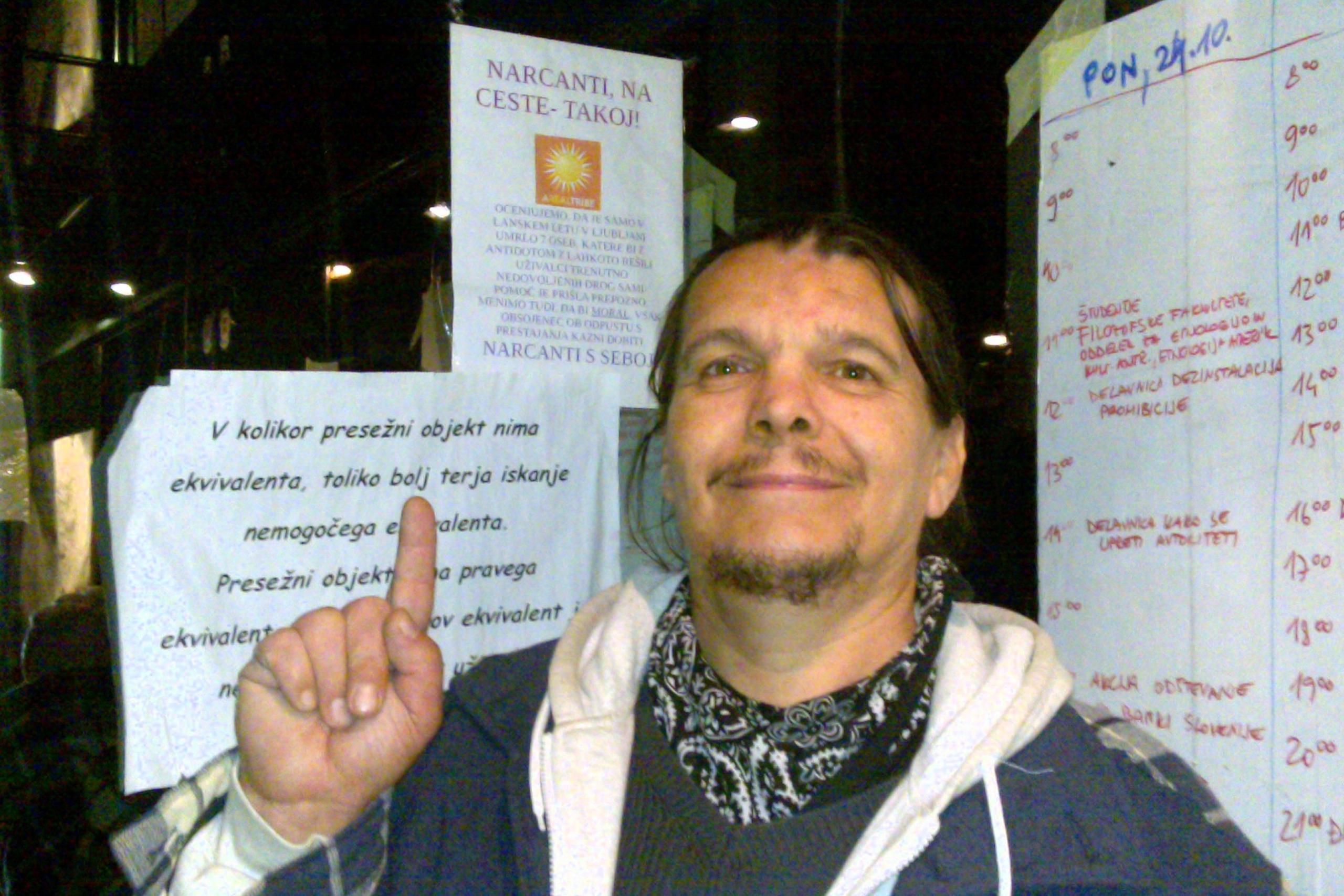
In my own country, Slovenia, major changes are on their way. On October 15th, several groups, individuals and NGO’s occupied the square in Ljubljana where the stock market is located. Shortly afterwards social workers and students from the Faculty of Social Science began to organise workshops. One workshop that has been organised regularly is called “ Disintegration of Prohibition”. The results of these workshops were gathered and collected in a “Manifesto of new Drug Policies in Slovenia”. On 27 October we handed this Manifesto over to the Minister for Health, Mr Marušič .

Another part of the protest was a Smoke In. It was not interfered with by Police, who just kept a vigilant presence. Our request to lawmakers is to decriminalise drug use and cancel all sanctions against people who were victims of penalisation of drug use or possession of small quantities in the past. Dignity must be returned to people who have been marginalised by drug prohibition. They have to be able to re-integrate in their community.
We are calling for all activists and practitioners in the field of drug policy to actively support changes in legislation. Now it’s time to redefine the world.
By: Janko Belin (with the help of Peter Webster)


ENCOD BULLETIN 81
In my view, what makes Legalisation & Regulation such critical an issue is the devastating effects Prohibition & the War on Drugs has had and continue to have on millions upon millions of people around the world, especially in drug producing countries.
Therefore, IT IS PROHIBITION ITSELF WHICH MUST BE ENDED. It should not be confined to a particular drug or to one side of the drug trade. It concerns not just marijuana, but all drugs; not only the Legalisation & Regulation of the demand but perhaps more importantly, the Legalisation & Regulation of the supply, too.
I do not have any doubts that the decriminalisation of the demand for drugs is a sensible policy; but if we were serious about tackling the ‘drug problem’, we should be accompanying those same policies with equally sensible policies towards the supply of drugs. We should also be promoting the legalisation of the supply; we should be the ones making all the noises calling for a change in the national and international legislation on drugs. In a nutshell, we should be spearheading the movement seeking to legalise the production and distribution of all drugs.
I do understand why the large majority in the so-called Drug Reform Movement in major drug consuming countries, like ours, favours a “pragmatic” approach when it comes to legalisation” (i.e. decriminalisation or depenalisation), but couldn’t disagree more. And I do so for the following reasons:
First, it suggests that the case against Prohibition & the War on Drugs cannot be won on its own merits, that is, that the Prohibition regime is irrational, ineffective and inefficient.
Second, many countries have already introduced harm reduction policies, have depenalised or decriminalised “de jure” or “de facto” the demand for marijuana and we are still waiting for further “quasi legalisation” of other drugs. There are exceptions, of course, such as Spain and Portugal.
Third, despite the fact that a large number of countries did “quasi legalise” the demand for marijuana long time ago, the supply remains illegal. And as far as I know, none of them has shown intentions of changing the status quo.
Finally, it seems to validate our solipsistic attitude to the drug problem in that the havoc our demand for drugs is wreaking in drug producing countries is not reason enough to win the case against the War on Drugs — by any standards, an inhumane, criminal and barbaric war.
Summing up, it may seem obvious that, being consuming countries, we ought to focus our attention on the demand, for that is what concerns us right here, right now. Perhaps, it is just a case of differentiating between tactics and strategy, between the short and the long term. In this case, it may be that for many in the Drug Reform Movement the priority is to undermine the prohibitionist regime on this side of the fence, and in the process, help dismantle the case for keeping the war on the supply of drugs. I wonder, however, if this piecemeal approach is warranted given the atrocious consequences of the War on Drugs on net producing countries, particularly in Latin America, for no rational, scientific or economic reasons. Sometimes, I wonder if we cannot be accused, for lack of a better term, of ‘drug imperialism’.
Gart Valenc
http://www.stopthewarondrugs.org
ENCOD BULLETIN 81
Hello Janko
Thank you very much for this bulletin and you say the thing’s like they are so other people can get finally a different view on what’s going on behind the scene.
And i hope that this will open many peoples and NGO’s eye’s
Perfect artikel on your first experience in the latest CSF meeting!
Keep up the good work and i wish you lot’s of succes!