releafmaltalogo

Malta and Cannabis: Changes on the horizon

Malta set to decriminalize up to 7 grams of cannabis and to allow the establishment of Cannabis Associations. 

In the past weeks, the Government of Malta tabled a Bill in the Maltese House of Representatives detailing a plan for a partial decriminalised system for the adult personal non-medical use of cannabis. Bill No. 241 to establish the Authority on the Responsible Use of Cannabis and to amend various laws relating to certain cannabis activities, is a bold statement in favour of a less criminalised and more humane approach. The Bill comes at an important juncture in Maltese and regional drug policy developments. In fact, Malta will be one of the first from the European family to take the lead on promoting a more humane and regulated approach to cannabis.

ReLeaf Malta has been instrumental in pushing forward a model which places the rights of people who consume cannabis at the helm of every decision and ensure no corporate takeover nibbles away personal rights and freedoms.

Principles of human rights, social equity and sustainability have been at the core of ReLeaf Malta’s message and proposed regulated framework. Collaboration with key international partners was key to ensure proposals are built on research and an evidence-based approach, prioritising humanity before profit and corporate greed. Collaboration with ENCOD, especially close consultation of the ENCOD’s European Guidelines for Cannabis Social Clubs was instrumental to create a holistic approach to allow the cultivation, consumption and sharing of cannabis in Malta.

Bill No 241, modelled, in part, on ENCOD’s proposal of a not-for-profit system collectively cultivating, consuming, and sharing cannabis, includes the following points:

Personal cultivation and consumption 

  • Persons aged 18 and over can have up to 7 grams in their possession and won’t be charged in court or face proceedings before a justice commissioner if caught. Police will no longer confiscate cannabis under 7 grams 
  • The possession of between seven and 28 grams of cannabis will be punishable with a fine of between €50 and €100, as well as proceedings before a justice commissioner 
  • Up to 4 cannabis plants will be allowed in private residences, but they must still be kept out of sight, and only up to 50 grams of dried cannabis in the residence 
  • Consumption of cannabis in public will remain illegal with the person being subjected to a fine 
  • Possibility to obtain clean police conduct for amounts decriminalised or depenalised by the new law  

Cannabis Associations operating and registered as NGOs with the Commissioner for Voluntary Organisations 

  • Adults over the age of 18 can form an NGO (Cannabis Association) to collectively cultivate and share cannabis. The Association needs to obtain a licence form the Authority on the Responsible Use of Cannabis. The Associations cannot be situated within 250 metres of a school or youth area 
  • Cannabis associations that distribute cannabis among their members will be allowed to operate as an NGO and not for profit 
  • Persons with previous criminal records cannot form an association 
  • Up to 7 grams a day can be distributed to each member with a maximum of 50 grams per month.  
  • The organisation will also be able to distribute up to 20 cannabis seeds/month to each member and cannot have more than 500 grams of the plant on their premises at any given time 
  • Cannabis is to be distributed in sealed containers, including labelling 
  • No marketing or visible signage should be included 

Whilst not promoting the use of cannabis, the Bill aims to provide increased legal safeguards for the personal consumption and cultivation of cannabis, whilst directly impact the illicit trade and monopoly of cannabis by allowing the establishment of associations providing a source of safe cannabis. The Bill should therefore also directly impact how local police handle cannabis-related offences and hopefully ensure less harassment of people who cultivate, consume and share cannabis.

Nonetheless, it is somewhat strange, that old bogus beliefs spread by ‘the war on drugs’, continue to seep in the new law and unfortunately in some areas distort the core aim of such a reform. One worrying reality is that in a way, the law still considers cannabis possession a crime, especially if the police have ‘reasonable suspicion’ of trafficking. Whilst recognising that the 50 gram/month limit allowed to be purchased from the associations is a courageous step forward (presently 3.5 grams are depenalised), better reflecting consumption levels, it is unclear why the same amount will be allowed for those cultivating up to 4 plants. Any person that cultivates cannabis will tell you that this limit is too low even for one consumer, imagine 4 residents living under the same roof and all using cannabis on a daily basis.

Another example is the complete ban on public smoking, especially for areas only frequented by adults. This is not applied for tobacco and although closed venues and other areas frequented by children prohibit the use of tobacco, in other open spaces tobacco consumption is not banned.

Recent comments by Minister Owen Bonnici have also cast doubt on how the government foresees the daily operation of the associations. In fact, he confirmed that no smoking will be allowed on the premises and people will only visit the association to purchase cannabis or seeds. This is in stark difference to what a not-for-profit social club built on harm reduction aims to achieve. In fact, the main purpose of a similar system is to provide a safe space for like-minded people to share an activity that brings them closer together and gives them the opportunity to share knowledge or seek help if experiencing problems. Most importantly, a system where people visit and stay within the association premises to consume cannabis would ensure closer dialogue between the person and the association, especially on matters pertaining to harm reduction and health. Once more the legislator continues to obfuscate the aims of a decriminalised system with the need of keeping consumers separate from each other, hidden at home, and immediately criminalised if not adhering to strict bureaucratic and unsustainable systems. In a way, this seems a step backward and makes a mockery of the basic human rights of freedom of assembly and of association.

It seems the proposed Bill has also in a mysterious way introduced a business opportunity for some, completely ignoring the fact that these associations will be operating as NGOs and on a not-for-profit basis. The requirement of sealed containers, is a very convenient way how some businesspeople, maybe already involved in the medicinal cannabis market, will make a profit out of this new system.

To oblige an NGO to pay for thousands of sealed containers to be used only once is a clear insult to our collective intelligence, to our sustainable and environmental promises, and a cheap way how commercial interests attempt to sabotage human rights and civil liberties law.

It is also a blatant reflection that cannabis is STILL considered as an illicit narcotic that needs to be sealed and kept hidden. Whilst acknowledging the importance to keep cannabis out of the reach of children, these strict measures imposed on NGOs, together with a complete ban of participation for people with a previous criminal conviction, create an unbalanced playing field from the very beginning. Ultimately, this approach seriously risks excluding those that have been so badly affected by prohibition and the current draconian laws. These provisions also risk increasing the price of cannabis (through membership fees or other means) and thus in no significant way compete with what is available and more accessible on the illicit market.

The Bill is now at its second stage. However, due to parliamentary debates related to the yearly Government Budget, discussions on the Bill have stalled before even starting. Rumors of an early election in November continue to crumble Malta’s green aspirations that the Bill will go through by Christmas. Despite these technical and political hiccups, ReLeaf Malta remains committed to ensure any legislative change continues to respect in full human rights, social equity, and sustainability.

Keeping optimistic is what has kept us going.

Now that Malta is going through this legislative and social transition, as a small but determined NGO, ReLeaf Malta continues to wave our shared green leaf, representing and championing the voice and rights of people who consume, cultivate, and share cannabis.
I want to read the full bill.


banner_F2F_klein

Pre-review of kratom at the WHO ECDD

Dr. Fabian Steinmetz gave a statement on kratom at the Forty-fourth Expert Committee on Drug Dependence.


Dear Expert Committee on Drug Dependence,
we would like to encourage the ECDD not to classify kratom (Mitragyna speciosa) as a controlled substance. First of all, banning plants has never solved any drugrelated issues. Products derived from hemp (Cannabis sativa), poppy (Papaver somniferum), and coca (Coca erythroxylum), and chemical substitutes are readily available worldwide. However, banning those plants inflicted direct and indirect harm to millions of people, particularly ethnic minorities. There is a scientific consensus that sensible regulations dependent on use prevalence and substancespecific risks are the best approach to reduce harm to health and society. A ban on kratom would particularly affect people with traditional and medical use. For many people, kratom is a safe pain medication or mild opioid substitute.

As a toxicologist and professional risk assessor, I would like to emphasise that many plant extracts in high concentrations have psychotropic effects but could also, at high and constant exposure, provoke organ toxicity, e.g. lavender (Lavandula angustifolia), mugwort (Artemisia vulgaris), tea (Camellia sinensis), chamomile (Matricaria recutita), lettuce (Lactuca spp) etc. Hence, this cannot be the rationale for banning a plant, particularly not if there is an overall long history of safe use.

While extracts/isolates should undergo regulatory approaches comparable to other plantbased pharmaceuticals (i.e. dependent on potency), it is important not to schedule the plant and traditional formulations to avoid obstruction of medical research, obstruction of current medical therapies as opioid substitute, analgesic etc. (particularly when access to healthcare is limited) and to avoid the general criminalisation of people using kratom. Particularly the latter is harmful on its own but also may lead to unhealthier substance choices. Hence, the cultivation, trade and use of kratom should not be prosecuted. This should also encompass novel formulations if typical alkaloid exposure is not exceeded.

Overall, the use prevalence is, compared to alcoholic beverages and hempbased products, not particularly high although the plant and its effects are known in the Western world for over 100 years. One reason might be the taste which is not perceived well by many people using kratom. Another reason might be unpleasant effects, e.g. dizziness, drowsiness, particularly at high doses. Due to the fact that the main alkaloid (mitragynine) is a proddrug towards the μopioid receptor, it is unlikely that other routes of administration than the oral route could lead to use patterns associated with severe substance use disorders (cf. first-pass effect). The active metabolite (7hydroxymitragynine) is also present in the plant but only in pharmacologically irrelevant trace levels. This clearly differentiates kratom’s main alkaloid mitragynine from cocaine or morphine.

The political challenges with regard to climate change and mass extinction should also remind us not to interfere with ecosystems lightheartedly. The kratom plant, growing as a tropical evergreen tree, is an important part of local ecosystems and these ecosystems should not be deliberately harmed. Despite that, we already know that banning plants has never been a successful strategy. When looking at other banned plants, it is not unlikely that banning the plant would even encourage more cultivation, extractions and eventually chemical alterations (cf. poppy to heroin or coca to cocaine hydrochloride/freebase).
Although, as described above, this is less likely with kratom, the creation of more harmful derivatives should be a reminder of negative consequences based on drug prohibition. Currently, kratom is considered a rather unproblematic remedy used by a rather small population, nevertheless, “technological progress” due to prohibition should not be underestimated. It is important not to give organised crime groups further opportunities to increase their market share.
Overall, considering health and social implications, the cultivation, trade, and use of kratom should not be prosecuted. Therefore, it is important to respect communities and their freedom to farm, use, and trade recreational and medical goods of low concern.

Kind regards,

Dr. Fabian Pitter Steinmetz

Member / Scientific Advisor of ENCOD

Click here to read the statement.

Click here for more information about the event.


Veverka v konopi

Education is not a crime!

Legalizace magazine and its editor-in-chief, Robert Veverka have been formally accused of “inciting and promoting toxicomania”, with penalties of up to five years of imprisonment. The first court hearing will take place on Tuesday, October 5 at 8:30 AM at the district court in the town of Bruntál, Czech Republic.

The goal of Legalizace magazine, a bimonthly periodical dedicated not only to cannabis, is to provide unbiased information about drug issues with regard to human rights and environmental protection. Since its founding in 2010, the magazine has published interviews with notable individuals, articles on drug legislation, cultivation technologies and methods, information about cannabis treatment, studies and scientific findings, news coverage from both the Czech Republic and abroad, and articles concerning history and culture.

According to Czech law, cannabis is considered a regular agricultural crop plant and also possesses the status of a medicinal plant, and its cultivation and processing is permitted in compliance with Act No. 167/1998 Czech Law Coll. without special permission. Given this fact, Legalizace magazine considers the criminal charges of “inciting and promoting toxicomania” not only an instance of systematic failure and demonstrable ignorance of cannabis legislation by the prosecuting authorities but also a gross infringement of freedom of expression and the right to information guaranteed by the Czech Charter of Fundamental Rights and Freedoms.

The prosecution, which is calculated, stigmatizing, borderline untruthful, and based on fallacious conjectures and limited interpretation by the police that the cultivation and processing of cannabis is automatically illegal or that any mention of cannabis automatically equates ‘inciting toxicomania’, comprises a dangerous precedent comparable to totalitarian repression and censorship. I consider it my duty to fight not only for the right of Legalizace magazine to exist, but also for the rights of all print and electronic media who have ever dared mention the word ‘cannabis’ – or plan to do so in the future,” said Robert Veverka, the editor-in-chief, regarding the indictment.

From its inception, the purpose of Legalizace magazine has always been to provide comprehensive, objective, and balanced information about the cannabis plant regarding its botanical, industrial, medicinal, and legal contexts. The aim has also been to point out the dismal state of drug policies, whose efforts do not fulfill the declared intention of a world without drugs. On the contrary, the current prohibition increases the risks of addiction and is primarily aimed at the repression of high-risk groups. Legalizace magazine has never incited its readers to abuse psychoactive substances of any kind – on the contrary, it has substituted the role of the state in situations where, for instance, legal cannabis patients are not provided enough information about how to handle prescribed cannabis or what kinds of risks or side effects can arise in connection to said cannabis use. According to expert opinions, Legalizace magazine is one of the most significant components of the tertiary prevention system in the Czech Republic in terms of protecting society from psychoactive substances and the negative effects of their abuse.

Legalizace magazine and its editor-in-chief invite all the public and media who care about the freedom of expression and the future of cannabis to attend the trial, which will take place on October 5, 2021 at 8:30 AM at the district court in the town of Bruntál, room 210A.

Contact for the media:
Robert Veverka, tel. +420 773 691 561, email: robert@legalpub.cz
Web: https://magazin-legalizace.cz/

FB: https://www.facebook.com/magazinlegalizace
FB Event: https://www.facebook.com/events/396682462064878

Robert Veverka is the publisher and editor-in-chief of Legalizace magazine, the head of the Legalizace.cz NGO, a member of the Prague Council Commission for Drug Policy Coordination, and a representative and member of the Security Commission and Education Commission of the Prague 2 municipal borough.

Diseño sin título

Barcelona City Council suspended the licenses of Cannabis Social Clubs

The Barcelona City Council is canceling the city’s plan that regulates the activities of cannabis social clubs here since 2016. The associations lose their municipal licenses and become private social clubs, which means that aspects such as location, health, or ventilation characteristics of this activity are no longer guaranteed. All of this is done under the pretext that the clubs are promoting the use and cultivation of cannabis, activities that these establishments have been banned from their existence.

The administrative dispute of the Supreme Court of Catalonia came to the conclusion in its Judgment 1627/2020 of June 2nd 2021 that the city council has no powers in relation to the regulation and order of these bodies because they can be prone to a crime and it is the judges who need to decide that. The Spanish Supreme Court rejected the last appeal in April this year. This decision sets a precedent for the rest of the Autonomous Communities where licenses for this activity still exist.

It requires the consistory to transform about  200 licensed CSCs into private social clubs. Then, city authorities will open a phase of intervention and control. It means that it will take a round of individualized inspections that could lead to the ordering of closures or the opening of criminal proceedings to various clubs and associations, as well as possible sanctions under criteria that are still unknown.

As impacts in the medium term, we can find the non-limitation of cannabis associations in the city and, therefore, possible overcrowding of these places without any rule on environmental, hygiene, health criteria or specific needs for their activity. This decision encourages illicit markets and opens the ban for organized crime groups, with the risk of city invasion with practices that generate different types of violence.

The new negligence of the Spanish authorities by restricting the regulatory powers of the city council encourages organized crime and the stigma of the social movement and makes it difficult to work to regulate this reality. Barcelona City Council recognizes “the need for the Activity Regulation from a public health perspective“.

Barcelona is the cradle of Cannabis Social Clubs. An internationally expanded regulatory model for cannabis that respects the rights and health of consumers and reduces their exposure to illegal markets. Social movements there have been demanding recognition for 20 years. Now is the time to take a step forward. Spain could lead the psychoactive cannabis regulation in the EU. Will the Spanish legislators have the courage to tackle this problem effectively, taking into account the civil society approach? Who knows.

To read the original post go to ConFAC.


Erec Hand & Topbud 2018-111

Recommendations for regulating the recreational use of cannabis in the European Union

TEMPLATE LETTER TO THE MEPs


Situational analysis


Every week, 90.2 million European citizens risk being sold a synthetic cannabis product
or cannabis contaminated with pesticide and other harmful substances.
Every day, criminal organisations continue to strengthen their market monopoly.
Every hour, 1% of European citizens risks being arrested by the police.


Rationale

The European Union Charter of Fundamental Rights underlines the importance of keeping the individual at the helm of every decision making and ensures that the universal principles of human dignity, freedom, equality, solidarity, democracy, security, sustainability, and rule of law are upheld for every European citizen. The four freedoms of the EU; free movement of people, goods and capital, and freedom of establishment, complement and strengthen the fundamental rights of the individual. Furthermore, adherence and full participation to the unifying and noble targets of sustainable development set by the UN Sustainable Developments Goals 2030, further enhance the critical nexus between justice, security, and well-being.

The EU Agenda and Action plan on drugs 2021-2025 [2] emphasises that:

The aim of the EU Agenda on Drugs is to protect citizens through better coordinated measures that will: (i) have a substantive and measurable impact on the security and health issues arising from drug use and the operations of the drug market; and, (ii) address both the direct and indirect consequences arising from this problem including links to violence and other forms of serious crime, related health, and societal problems, environmental damage, while raising public and policy awareness on these issues.

Furthermore, prevention and awareness, including addressing stigma are identified as key to prevent substance use and harms associated with it. The priorities also propose the introduction of wider harm reduction measures and alternatives to coercive methods.

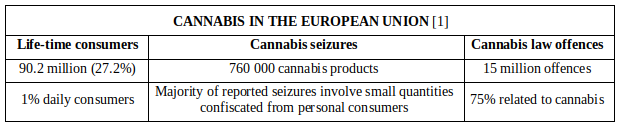
When looking at the prevalence of cannabis consumption in the European Union standing at 27.2% and cannabis law offences amounting to 75% of all European union drug law offences (majority of reported seizures involve small quantities confiscated from personal consumers), the draconian European approach is evidently causing more harm than good. The current policy frameworks adopted by national governments, predominantly criminalising and persecuting personal consumers and cultivators, continues to propagate an environment of discrimination and injustice.

Some European Union Member States have since the early 1990s recognised that the criminalisation of the personal cultivation, consumption and sharing of cannabis is not conducive to better public health and social well-being outcomes for the community. These initiatives, together with other policy changes in the years that followed, introduced various legislative measures to address the widespread consumption of cannabis and primarily separate the personal consumer and cultivator from the criminal justice system. The shift towards a decriminalised system aims to directly disrupt the monopoly of the illicit drugs market, whilst ensuring law enforcement agents direct their attention and resources towards more pressing and violent crimes such as domestic violence, human trafficking, money laundering, and homicide.

Furthermore, it may be advisable to view regulation as a process in which revisions and corrections are not seen as failures, but pave the way for efficient regulation that promotes health policy goals. To make this possible, the necessary flexibility in implementation should be planned for from the beginning. After all, an innovation such as the regulation of the cannabis market primarily involves a social, but also legislative learning process, which is accompanied by progress and setbacks. In order to be able to continuously take into account new experiences in regulation, coordination and evaluation are cornerstones of any regulation.


Recommendations for the Members of the European Parliament and the EU Member States

Considering the core European values of defending and upholding human dignity, freedom, and equality for all European citizens, included in the European Union Charter of Fundamental Rights [3], particularly Article 7; respect for private and family life, Article 8; protection of personal data, Article 12; freedom of Assembly of Association, and Article 21; Non-discrimination;

Noting the UN International Guidelines on Human Rights and Drug Policy [4] placing human dignity and sustainable development at the centre of Member State responses to illicit drug economies;

Noting the aims and priorities of the EU Agenda on Drugs (2021-2025) particularly enhanced security measures to disrupt criminal organizations, the use of alternatives to coercive methods, and broader inclusion of harm reduction tools to educate citizens and mitigate harm originating from substance use;

Recognising the potential risks associated with driving and operating heavy machinery under the influence of psychoactive substances and the need to ensure road-side testing reflects clinically determined impairment levels [5];

Considering the high prevalence of cannabis consumption in the EU standing at 27.2% of life-time consumers and 1% of daily consumers;

Considering the large proportion of cannabis law offences amount to 75% of all drug related offences and the shocking reality that the majority of reported seizures involve small quantities confiscated for personal consumption;

Considering the current inconsistency between member state’s approach to a non-violent personal choice to consume, cultivate and share cannabis, and the various legislative changes and ongoing discussions at national level to decriminalise the personal consumption and cultivation of cannabis;

  1. Calls on the European Parliament to recognise the unjust and dangerous reality of criminalising a personal and private matter of consuming, cultivating, and sharing cannabis, including its derivatives and products;
  2. Calls on the European Parliament to honour the rights and freedoms enshrined in the EU Charter of Fundamental Rights for people who consume cannabis and promote an inclusive and regulatory framework built on human dignity, respect for private life, and social justice;
  3. Urges the European Parliament to take a strong stance in favour of human rights, public health, and harm reduction for all people, including people who use cannabis, and promote effective approaches to disrupt the criminal drugs market;
  4. Invites the European Parliament to recognise the health and social benefits of allowing self-cultivation and encourages the Member States to discuss the amount of plants allowed to grow per person for personal use;
  5. Invites the European Parliament to recognise the health and social benefits of Cannabis Social Clubs (CSC) and encourages the Member States to facilitate the creation of CSC [6];
  6. Urges the European Parliament to encourage the Member States to introduce the expungement of criminal records for non-violent and non-harming cannabis convictions and ensure any administrative sanctions adopted in the case of a breach of rights are proportionate and do not impinge on the fundamental rights of European Union citizens;
  7. Encourages a more active and inclusive approach with civil society organisations directly working with people who consume cannabis, including cannabis growers’ cooperatives and experts in the field of cannabis, and promote a European-wide campaign on safe, organic, and sustainable personal cultivation practices.

______________

[1] EMCDDA. (2020). European Drug Report 2020: Trends and Developments. Publications Office of the European Union: Luxembourg.

[2] European Commission. (2020). EU Agenda And Action Plan On Drugs 2021-2025. Communication from the Commission to the European Parliament, the Council, the European Economic and Social Committee and the Committee of the Regions. Brussels, 24.7.2020, Com(2020), 606 Final.

[3] European Convention. (2012). Charter of Fundamental Rights of the European Union (CFR). Official Journal of the European Union, 26.10.2012, C 326/391.

[4] United Nations. (2019). International Guidelines on Human Rights and Drug Policy.

[5]    Source: Dr. Fabian Pitter Steinmetz

[6] ENCOD. (2020). The Cannabis Social Club Guidelines.


Screenshot at 2021-04-16 18-13-16

Rolling into the future: Recreational cannabis legislation in the EU

Dear friends and members,

On Monday 19th of April at 10.30 (CET) we are inviting you to watch the conference organised by MEP Cyrus Engerer and ENCOD about the future of recreational use of cannabis in the European Union.

At the conference, we will look into the different kinds of policies currently in place across Europe and focus on policy options that respect the rights of people who consume cannabis, whilst pursuing and promoting health and harm reduction strategies. Regulation should be viewed as a continuous process whereby revisions and corrections are not interpreted as failures, but rather as interesting crossroads and paths that pave the way towards a human- and health-centred policy.

See the complete video of Dr. Mireia Ventura about harm reduction and the contamination of cannabis with synthetic cannabinoids.


Program

Introductory Remarks by MEP Cyrus Engerer (Malta)

Video messages from the Member States: Portugal (prof. dr. Ximene Rego, University of Minho and prof. dr. Olga Souza Cruz, University Institute of Maia), Malta (Andrew Bonello, Releaf), The Netherlands (Derrick Bergman, VOC), Spain (Oscar Parés, ICEERS), and Belgium (Michel Degens, Mambo Social Club)

Panel 1) Human Rights and Drug Policy

TITLE: The sustainability of current cannabis policies and practices (Moderator: Mr. Jonathan Cilia)

Video message: The (illegal) cannabis market in Italy and the economic implications of its legalization: prof. dr. Marco Rossi, University of Rome

Panel discussion:

Tom Blickman, Transnational Institute (NL)

Péter Sárosi, Rights Reporter Foundation (HUN)

Prof. Dr. Justus Haucap, economist (GER)

Dr. Constanza Sánchez, International Center for Ethnobotanical Education, Research and Service (ESP)

MEP Alviina Alametsä (FIN)

Panel 2) Rolling into the Future

TITLE: Essential policy principles for the recreational cannabis law (Moderator: Mr. Jonathan Cilia)

Introduction: MEP Mikuláš Peksa (Czech Republic)

Cannabis Social Clubs: prof. Dr. Mafalda Pardal (Ghent university)

Quality assurance, staff education, and harm reduction: Dr. Mireia Ventura (Energy Control)

Freedom to Farm: Dr. Maja Kohek and Gabriele Kozar (ENCOD)

Cannabis and driving – European Union guidelines on standardized field sobriety tests: Dr. Fabian Pitter Steinmetz (toxicologist)

Final remarks by MEP Cyrus Engerer (Malta)

Join us on the 19th of April 2021 at 10.30 (CET)!